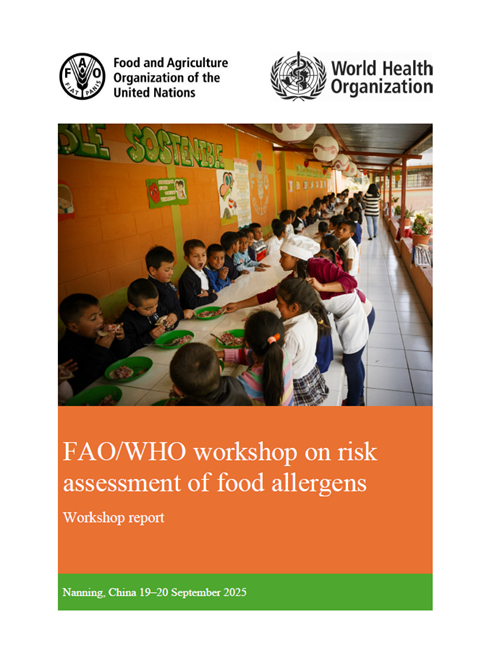
FAO/WHO workshop on risk assessment of food allergens
Nanning, China 19–20 September 2025
Overview
This FAO/WHO workshop in China (September 2025) brought together over 60 experts from 11 countries across Asia, Africa and Latin America to address and learn more about the growing challenge of food allergens. The primary goals were to enhance the capacity of Members in conducting food allergen risk assessments, reinforce the importance of moving from hazard to risk for food allergen assessment and management, and ensure alignment with the latest international standards.
The workshop provided participants with the latest science and methodologies developed by the Food and Agriculture Organization of the United Nations (FAO) and the World Health Organization (WHO) to help them assess and manage food allergen risks. Participants appreciated the opportunity to attend the workshop. The participants also noted challenges such as diverse regulatory or risk assessment frameworks and standards, and resource limitations. Through expert-led sessions and interactive discussions, participants considered real-world scenarios and conducted practical exercises to gain the necessary knowledge and tools to identify, evaluate and manage food allergen-related risks. A field visit to a food business operator (FBO) producing dairy products provided an opportunity for real-world insights into food allergen management and allowed participants to evaluate the case-by-case approach to food allergen risk assessment applied in the industry.
Key recommendations included convening similar events in different regions to strengthen the capacity of managing food allergens’ risk; developing supplementary guidance for the implementation of harmonized food allergen risk assessments (case studies, end-user guidance); and continuing collaboration between Codex members, relevant Codex Committees (e.g. the Codex Committee on Food Labelling [CCFL], the Codex Committee on Food Hygiene [CCFH], the Codex Committee on Methods of Analysis and Sampling [CCMAS]) and national authorities to refine tools and promote consistent, harmonized food allergen risk assessment and risk management through the whole food supply chain (from production to consumption), facilitating fair trade practices, transparent labelling and protection of consumers with food allergies.