
Noncommunicable Diseases, Rehabilitation and Disability
We are responsible for leading, coordinating and monitoring global action to cover additional people with health services, medicines, vaccines, diagnostic and health technologies for the prevention, screening, early diagnosis and appropriate treatment of cardiovascular diseases, cancers, chronic respiratory diseases and diabetes. We aim to advance health equity for persons with disabilities, we have a focus on sensory impairments and bring together the work on rehabilitation from across the departments and from the 3 levels of the organization.
Eye care, vision impairment and blindness programme
Eye conditions are remarkably common and many eye conditions can lead to vision impairment, including blindness. Those who live long enough will experience at least one eye condition during their lifetime. Globally, at least 2.2 billion people have a vision impairment. In at least 1 billion – or almost half – of these cases, vision impairment could have been prevented or has yet to be addressed.
The work of WHO’s Eye care, vision impairment and blindness programme is guided by World Health Assembly resolutions WHA78.7 Primary prevention and integrated care for sensory impairments, WHA73.4 Integrated, people-centred eye care and the recommendations of the WHO World report on vision (2019). The strategic recommendations and technical tools provided by WHO aim to assist Member States and their partners in reducing the burden of eye conditions and vision impairment while working towards achieving the Sustainable Development Goals (SDGs), specifically SDG target 3.8 on universal health coverage.
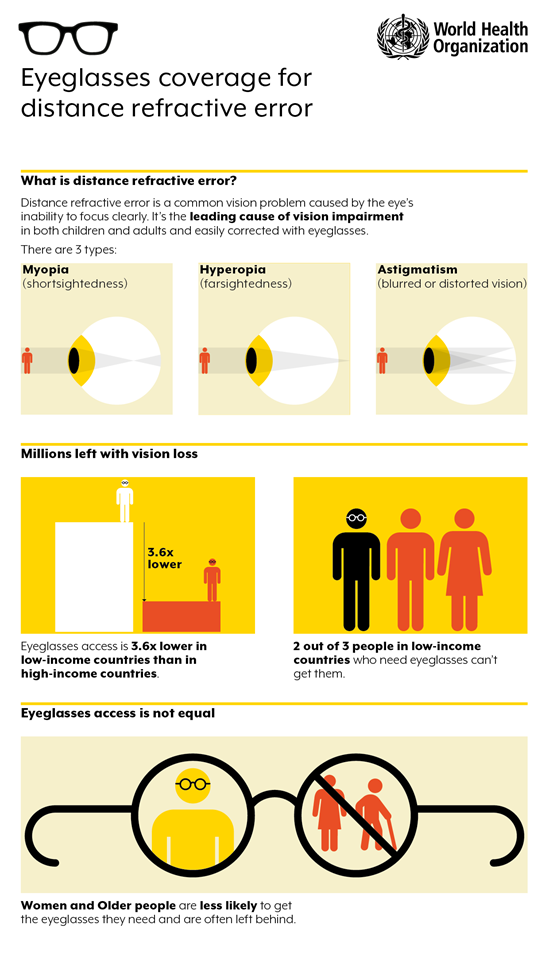
The two main causes of vision impairment are unoperated cataract and uncorrected refractive error. Given the large unmet need for cataract surgery and refractive error care, coupled with the fact that highly cost-effective interventions exist for these conditions, two global targets on effective coverage of eye care for 2030 were endorsed at the World Health Assembly in 2021. These targets aim to improve eye health coverage while ensuring quality care.
Highlights


Our work
Publications
All →
The Policy considerations to improve access to refractive error care provides a list of policy actions to be implemented to improve access to refractive...
This planning guide provides a structured framework to support countries in developing and integrating vision rehabilitation services within national health...
The Summary of recommendations for quality of care in cataract surgery management, developed by the World Health Organization (WHO), provides practical,...
Documents
All →
The Policy considerations to improve access to refractive error care provides a list of policy actions to be implemented to improve access to refractive...

The Planning guide for integrated vision rehabilitation provides a structured framework to support countries in developing and integrating vision rehabilitation...
29 May 2025
WHO Vision and eye care resources
WHO comprehensive list of vision and eye care programme resources.