
Resources
On 14 March 2023, Shagufta (right) and Khadija (left) receive mosquito nets during a door-to-door campaign for malaria treatment and prevention in Sohbatpur, Balochistan.
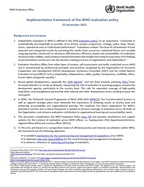
WHO Evaluation offers a range of practical resources to support high-quality, credible, and useful evaluations across the Organization. These tools guide evaluation planning, implementation, reporting, and capacity building, and are aligned with WHO’s Evaluation Policy and United Nations Evaluation Group (UNEG) standards.
Guidance
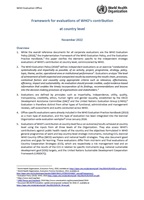
WHO South-East Asia Regional Framework for Strengthening Evaluation for Learning...
Guidance note on integrating health equity, gender equality, disability inclusion...
Evaluation report writing guidance
Independent reviews
Comparative review of WHO’s evaluation function
This independently commissioned comparative review examined WHO’s evaluation function at both global and regional levels, alongside eight UN agencies with strong evaluation systems (FAO, ILO, UNDP, UNESCO, UNFPA, UNHCR, UNICEF and WFP). The purpose was to identify good practices in governance, coverage and resourcing that support independent, credible and useful evaluations. While WHO has a unique structure and mandate, the study offers practical recommendations to improve its evaluation policy, systems and practices, and to enhance learning, accountability and effectiveness across the Organization.

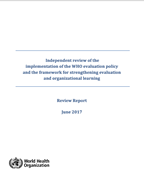
Independent review of the implementation of the WHO evaluation policy and the framework for strengthening evaluation and organizational learning (2017)
The objective of this independent review of the evaluation function at WHO was twofold: (i) to assess the implementation of the WHO evaluation policy and inform its update to ensure that WHO meets its evaluation-related reform objectives; and (ii) to assess the implementation of the WHO framework for strengthening evaluation and organizational learning in order to identify areas in need of strengthening.