Multisectoral Actions in Food Systems (AFS)
The multisectoral Actions in Food Systems (AFS) Unit defines implementation tools to strengthen food systems; support multisectoral policies to improve safety, quality and sustainability of food; engages with stakeholders in the food chain, and monitors policy implementation. The Unit provides support to WHO’s Member States in reducing the burden of diseases caused by unsafe food, unhealthy diets, and malnutrition in close collaboration with UN partner agencies, and other international organizations and stakeholders.
News
All →Technical information
Groups
Campaign and Initiative
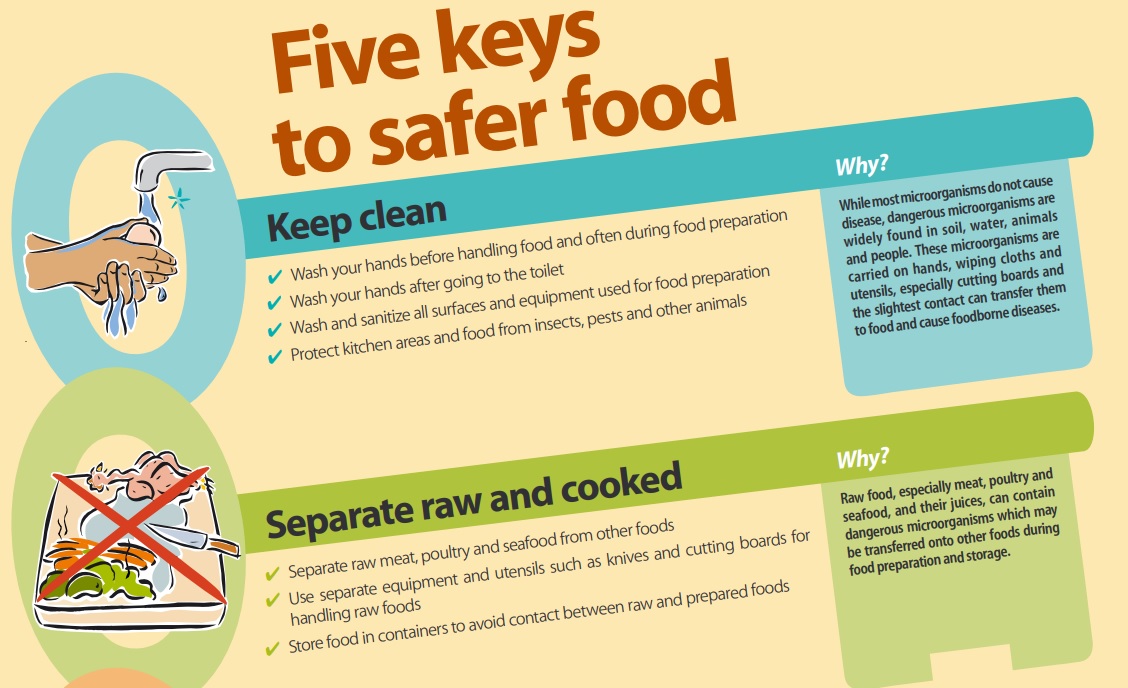
Five keys to safer food
Videos

This animated film was developed to explain the WHO Five Keys to Safer Food to general public from 9 to 99 years old, and encourage their practice at home. The Five Keys to Safer Food is a WHO global health message that everybody should know all over the world to prevent foodborne diseases and improve health.
Albanian
Arabic
Azerbaijani
Azerbaijani (short)
Bosnian
Cantonese (subtitled in Chinese)
Chinese
English
English (short)
Poster
Publications
All →Implementation guidance on the management of wasting and nutritional oedema (acute malnutrition) in infants...
This implementation guidance supports governments and implementing organizations in adapting and adopting recommendations and good practice statements...

Implementation guidance on donor human milk banking: organizational characteristics and regulatory classification
When mother’s own milk is not available, WHO recommends donor human milk for feeding preterm or low-birth-weight infants, preferably supplied through...
Strategic framework to guide health and nutrition actions in response to increased malnutrition and health...
The role and added value of the health sector during food crises are crucial in addressing the relationship between poor nutrition, disease and mortality...
Assessment tool
Food control system assessment tool: dimension D: Science / Knowledge base and continuous improvement
Dimension D looks at the necessary features for the system to build its scientific soundness and to keep abreast of new scientific developments and innovations,...
Dimension C identifies the interactions that must take place for the system to regularly adjust to national and international stakeholders’ evolving...
Dimension B focuses on the processes and the outputs of the national food control system. It revolves around the control functions that must be exercised...
Dimension A aims at mapping the fundamental elements necessary for the system to operate. These range from legal and policy instruments to financial assets,...
National food control system plays a pivotal role in protecting the health of consumers and ensuring fair practices in food trade. When we are able...
Documents
All →/nutrition-and-food-safety-(nfs)/food-nutrition-action-in-health-systems-(ahs)/cover_advocacy-brief-breastfeeding-investment-case.tmb-144v.png?sfvrsn=f566e718_1)
Investing in breastfeeding saves lives and money
Investments in breastfeeding support yield some of the highest returns on human capital, yet proven, evidence-based interventions, including counselling,...

The State of Food Security and Nutrition in the World 2026 (SOFI) is the UN system’s flagship assessment of global hunger, food insecurity and malnutrition,...

Joint FAO/WHO expert meeting on microbiological risk assessment on powdered formula for infants and young...
A Joint FAO/WHO Expert Meeting on Microbiological Risk Assessment (JEMRA) on powdered formula for infants and young children was convened in Rome, Italy,...